TOPODRONE Sony ILX-LR1 with LR1 Control Module is the next-generation photogrammetric system after TOPODRONE P61. It is built on the Sony ILX-LR1 industrial camera with a 61 MP full-frame sensor and a mechanical shutter and is mounted on the DJI X-Port 3-axis gimbal.
The TOPODRONE LR1 Control Module (LR1 CM) survey-grade GNSS receiver is a compact control unit that attaches to the camera with a quick-release mount. The unit has its own built-in Linux-based computer, so the camera appears in the DJI Pilot 2 app as a payload, and it is controlled (shutter release, exposure parameters, settings) from the drone remote controller.
The system determines the coordinates of the camera centers in two modes:
- PPK - from raw satellite measurements of the LR1 Control Module receiver and base station data, with post-flight processing in TOPOSETTER (chapter 14.1);
- RTK - from real-time corrections of the RTK module of the DJI Matrice 400 / 350 RTK drone (chapter 7).
Select the mode before the survey and perform all work in it. Photogrammetric processing is performed in TOPOMAPPER (chapter 14.2). For information on PPK and RTK technologies, see the TOPODRONE knowledge base (topodrone.com/knowledge).
The camera supports AGROWING multispectral lenses - see chapter 15.
Two ILX-LR1 cameras with LR1 Control Module can be installed on one drone using the DJI Dual Gimbal Connector - parallel data collection in one flight ("Dual Gimbal" kits). This manual covers the single configuration; the specifics of two cameras are described in chapter 8.4.
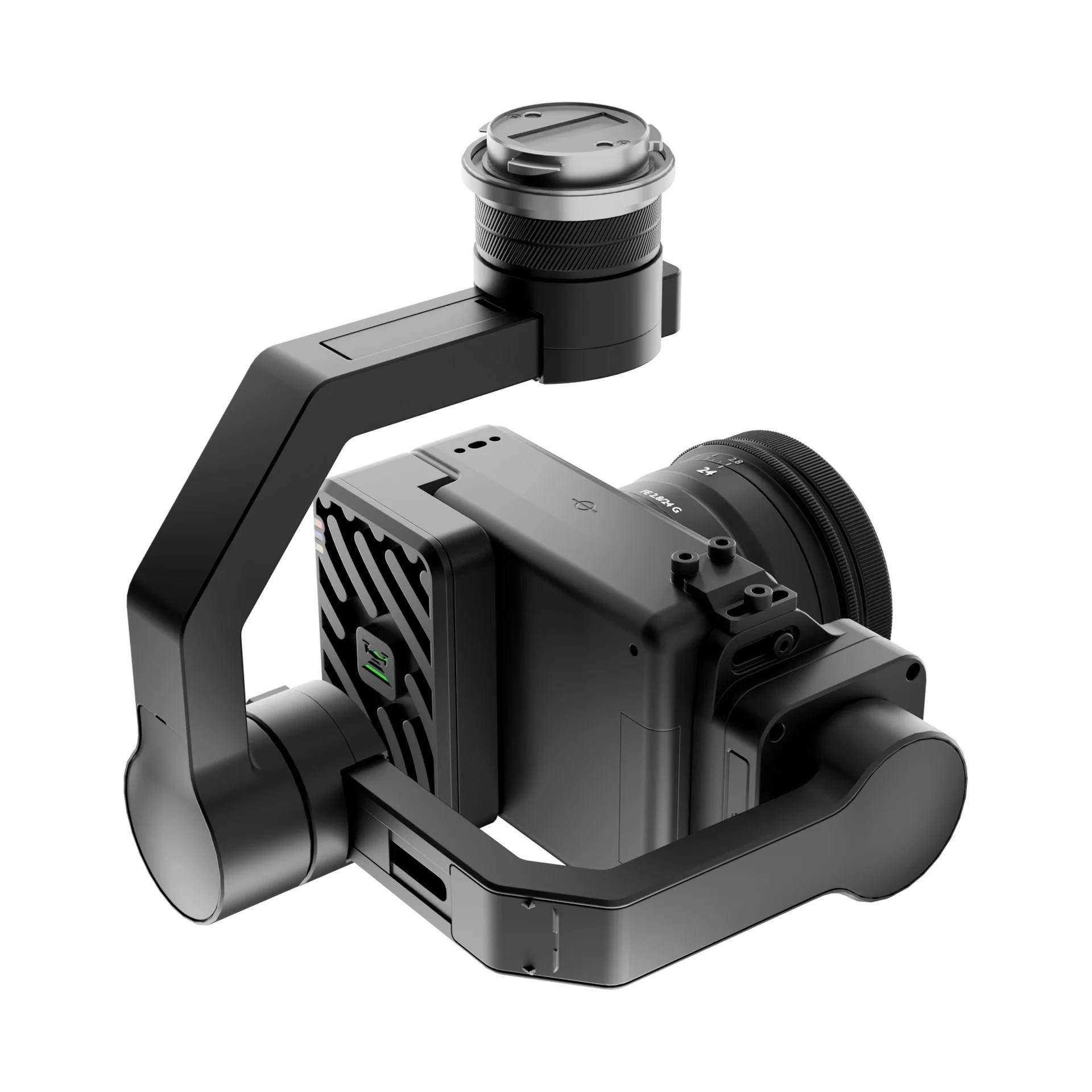
Sony ILX-LR1 with the TOPODRONE LR1 Control Module on the DJI X-Port 3-axis gimbal.
2.1 Package Contents
The "Sony ILX-LR1 with TOPODRONE LR1 Control Module M400/M350 Kit" includes:
- Sony ILX-LR1 camera;
- TOPODRONE LR1 Control Module;
- X-Port mount (for DJI Matrice 400/350);
- Connection cables;
- microSD memory card.
The lens is supplied depending on the ordered configuration (see chapter 2.4).
2.2 System Design
The system consists of three assemblies: the Sony ILX-LR1 camera with lens, the DJI X-Port 3-axis gimbal and the TOPODRONE LR1 Control Module, attached to the camera with a quick-release mount. The control unit has a microSD memory card slot for recording GNSS measurements.
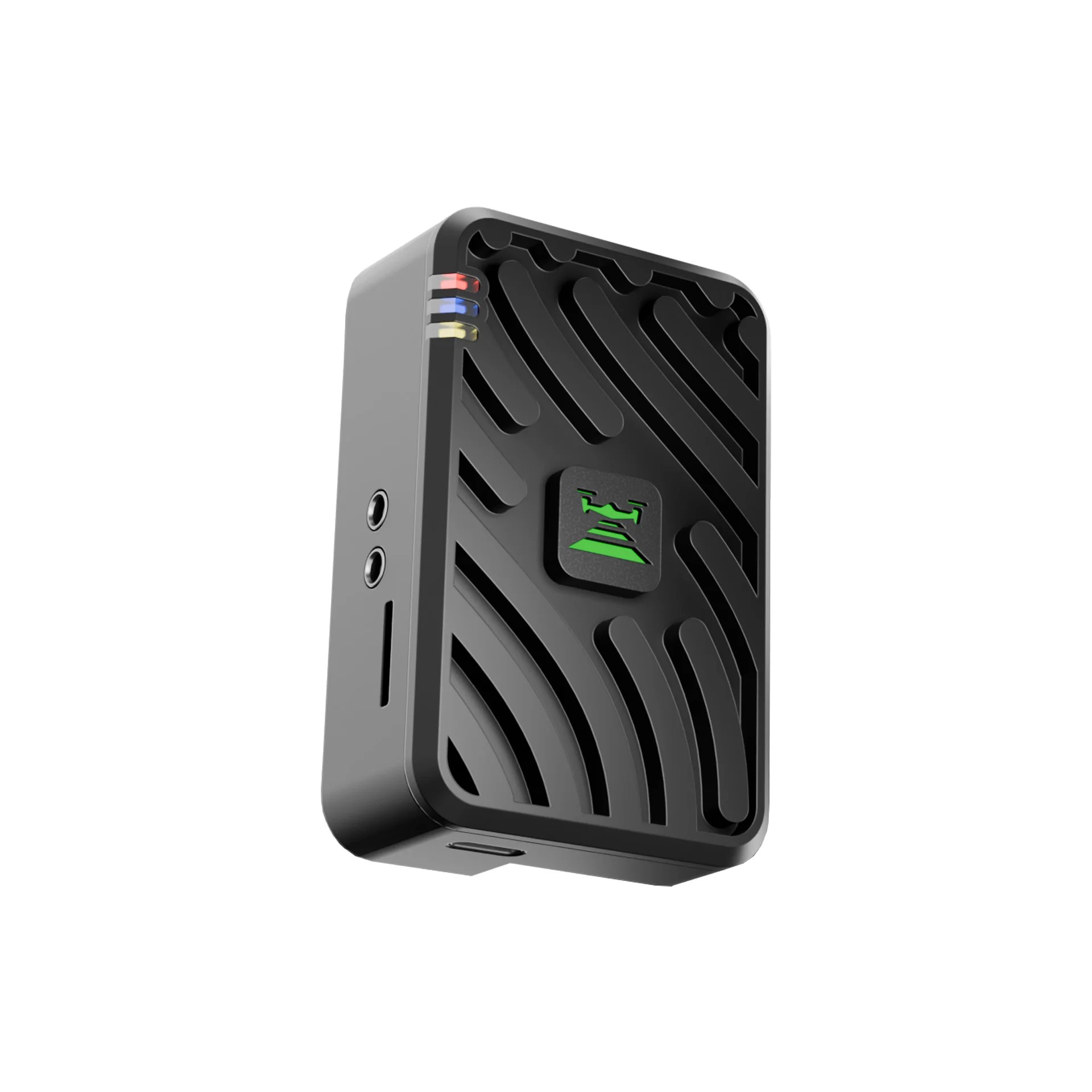
TOPODRONE LR1 Control Module.
2.3 Supported Aircraft
The system is fully integrated with DJI Matrice 400 and DJI Matrice 350 RTK drones via the X-Port interface: the camera is controlled with the standard remote controller, and the video stream is transmitted in real time to the DJI Pilot 2 app.
2.4 Compatible Lenses
The system supports full-frame Sony E-mount lenses within the payload weight and size limits.
Recommended lenses:
| Lens | Part number | Note |
|---|---|---|
| Sony FE 24mm f/2.8 G | SEL24F28G | - |
| Sony FE 28mm f/2.0 | SEL28F20 | - |
| Sonnar FE 35mm f/2.8 ZA | SEL35F28Z | - |
| Sony FE 40mm f/2.5 G | SEL40F25G | - |
| Sony FE 50mm f/2.5 G | SEL50F25G | - |
| Sigma 17mm f/4.0 DG | - | increased weight and size |
Compatible with limitations:
| Lens | Limitation |
|---|---|
| Sony FE 16mm f/1.8 G (SEL16F18G) | increased weight and protruding front element |
| Sonnar FE 55mm f/1.8 ZA (SEL55F18Z) | increased barrel length |
Multispectral lenses: AGROWING Quad 25mm, AGROWING Quad 55mm and AGROWING Sextuple 21.8mm (see chapter 15).
Other full-frame Sony E lenses can be used if their weight and size are within the system limits. Heavier or longer lenses can disturb the gimbal balance, flight stability and data collection accuracy.
For drone operation, it is recommended to use fixed focal length (prime) lenses.
2.5 Sony ILX-LR1 Camera Specifications
| Specification | Value |
|---|---|
| Camera type | Industrial, full-frame, interchangeable lens |
| Lens mount | Sony E |
| Sensor | Full-frame Exmor R CMOS, approx. 61 MP |
| Sensor size | 35.7 × 23.8 mm |
| Maximum image size (3:2), px | 9504 × 6336 |
| Image processor | BIONZ XR |
| Shutter | Mechanical (focal-plane) |
| ISO range | 100-32000, extended 50-102400 |
| Shutter speed range (mechanical shutter) | 1/4000 - 30 s, BULB |
| Shutter speed range (electronic shutter) | 1/8000 - 30 s |
| Exposure compensation | ±5.0 EV |
| File formats | JPEG, HEIF, RAW (Sony ARW) |
| Memory cards | SD, SDHC, SDXC (UHS-II) |
| Interfaces | USB Type-C (USB 3.2), Micro-HDMI, power and control connector |
| Power supply | 10-18 V DC |
| Power consumption (still shooting) | approx. 3.8 W |
| Operating temperature | 0 ... +40 °C |
| Storage temperature | -20 ... +55 °C |
| Body dimensions (without lens) | 100 × 74 × 42.5 mm |
| Body weight (without lens) | 243 g |
Source: the official Sony Help Guide for ILX-LR1 (helpguide.sony.net/ilc/2390), "Specifications" section.
2.6 TOPODRONE LR1 Control Module Specifications
| Specification | Value |
|---|---|
| Positioning modes | PPK, RTK (via the DJI drone RTK module) |
| Number of channels | 1408 |
| GNSS data recording rate | 20 Hz |
| Positioning accuracy, PPK | 3-5 cm |
| GPS | L1C/A, L2C, L1C, L2P (Y), L5 |
| GLONASS | L1, L2, L3 |
| BeiDou | B1I, B2I, B3I, B1C, B2a, B2b |
| Galileo | E1, E5b, E5a, E6 |
| QZSS | L1, L2, L5 |
| SBAS | L1C/A |
| Operation without ground control points | Yes |
| GNSS data recording | to microSD card |
| Maximum microSD card capacity | 32 GB |
| Built-in computer | Linux |
| Camera control from the remote controller | Yes (shutter release, exposure, settings) |
| Two payloads | Yes, via DJI Dual Gimbal Connector |
| Country of manufacture | Switzerland |