The system is intended for use in open terrain in weather without precipitation.
Operation in rain, snow, frost, hail or fog is prohibited.
The equipment has no IP rating. If moisture gets on the lens or inside the device, data quality degrades and the electronics may be damaged. If precipitation begins, stop the survey, land the drone, disassemble the equipment and wipe it with a dry cloth or tissue. Keep 1-2 silica gel bags in the case to absorb moisture.
The operating temperature range of the Sony ILX-LR1 camera is from 0 to +40 °C.
Operation at sub-zero temperatures and high humidity (above 80%) can lead to icing of the equipment and the drone. This degrades data quality and can cause the drone to crash due to propeller icing. Before starting work, warm up the equipment for 3-5 minutes in a warm room.
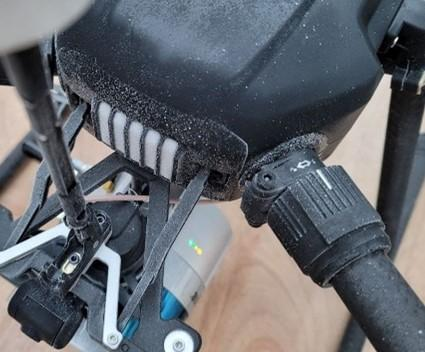
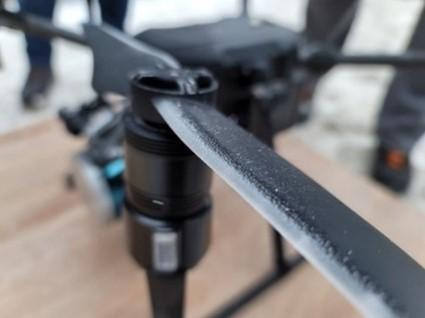
Drone icing in flight at -18 °C and propeller icing.
Surveying water surfaces is ineffective due to the small number of tie points on water during photogrammetric processing.
For correct post-processing, fly at least 4 parallel passes (flight lines) with forward and side overlap of at least 65%. Surveying in one or two passes is ineffective and leads to large distortions and low accuracy. The recommended flight speed is from 5 to 15 m/s depending on the altitude and forward overlap.
If the GNSS signal is insufficient or absent, operation is pointless. The minimum number of visible satellites is 8. Before the flight, check the weather conditions and the number of visible GNSS satellites, for example in the UAV Forecast service.
Handle the front lens element with care. Do not allow sand, dirt, dust, water, metal shavings or other abrasive and chemically active substances to get on any equipment components.
The manufacturer is not responsible for equipment failure when operated outside the recommended conditions.