








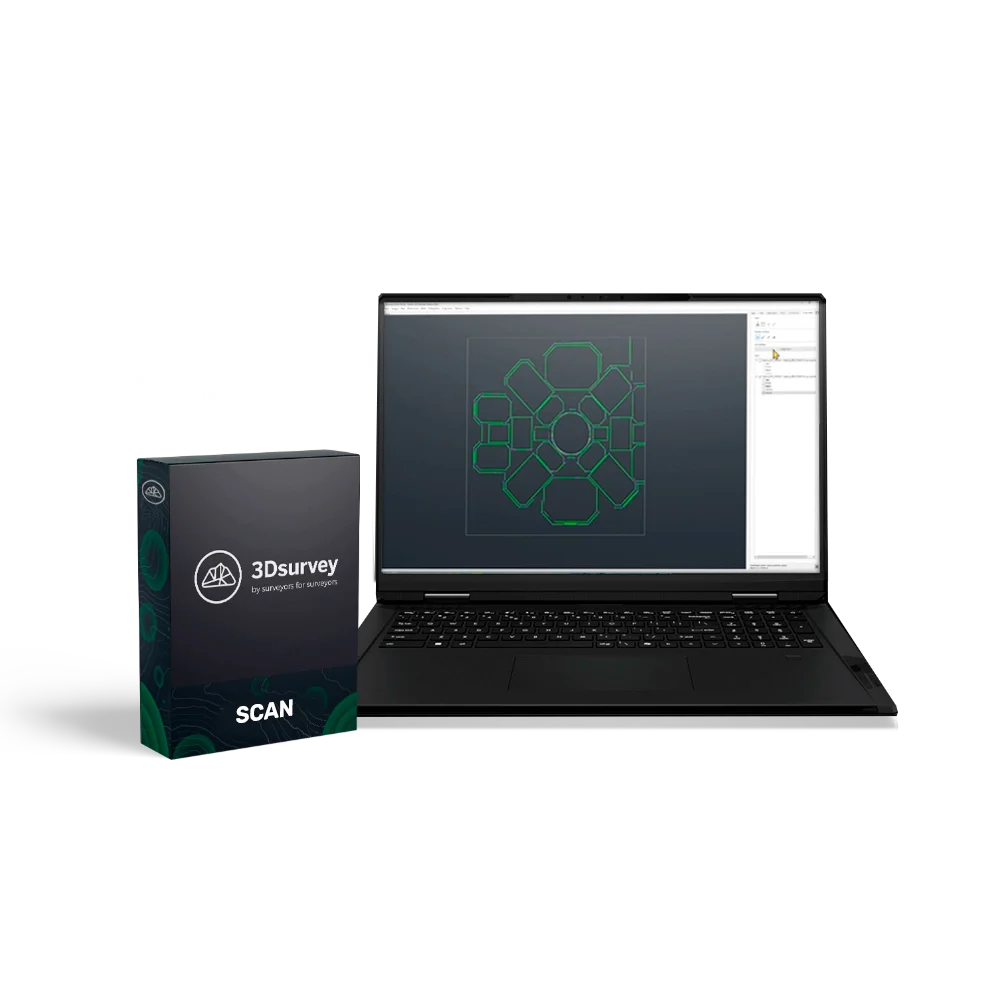
3Dsurvey SCAN, 1 Month

3Dsurvey SCAN is a specialised module for merging, aligning and analysing point clouds obtained from various sources: LiDAR, SLAM, photogrammetry and other 3D scanning technologies. The software supports both automatic and manual data registration, viewing of 360° panoramas, X-ray projections and automatic extraction of lines for creating accurate CAD drawings and plans.
Thanks to support for spherical images and tools for visualising scanning attributes, 3Dsurvey SCAN transforms complex point clouds into clear, ready-to-use results — whether they are floor plans, orthophotos or engineering diagrams.
SCAN 3-Month Licence
The licence provides access to the additional SCAN module for 3 months with the option of further renewal.
Advantages:
- Unified 3D data environment — merging point clouds from different sources without loss of accuracy.
- High-precision alignment — the automatic ICP-based registration algorithm minimises distances between points.
- Interactive 360° panoramas — view and annotate scenes directly inside the point cloud.
- Intelligent line extraction — automatic detection of building and structure contours to speed up plan creation.
- Scanning attribute visualisation — display intensity, timestamp and laser returns for detailed data analysis.
- CAD integration — export results in a format ready for engineering processing and design.
- Orthophoto generation from point clouds — fast conversion of 3D data into accurate 2D imagery.
Functionality:
- Manual and automatic point cloud registration.
- Viewing 360° spherical images from SLAM devices.
- X-ray view for creating plans and profiles.
- Automatic detection of contours and structural lines.
- Visualisation of scanning attributes: intensity, time, path, number of returns.
- Generation of orthophotos from point clouds with RGB data.
Areas of application:
3Dsurvey SCAN is used across a wide range of professional tasks requiring high-precision spatial data:
- Geodesy and mapping — processing LiDAR and photogrammetric data.
- Construction and BIM — creating accurate plans, facades and 3D models of existing structures.
- Architecture and restoration — documenting and analysing historical buildings and monuments.
- Engineering surveys — building digital terrain models, utilities and infrastructure.
- Urban planning — analysing spatial data and updating cadastral information.
- Mining and industrial sectors — volume control, inventory and facility monitoring.