








Contents

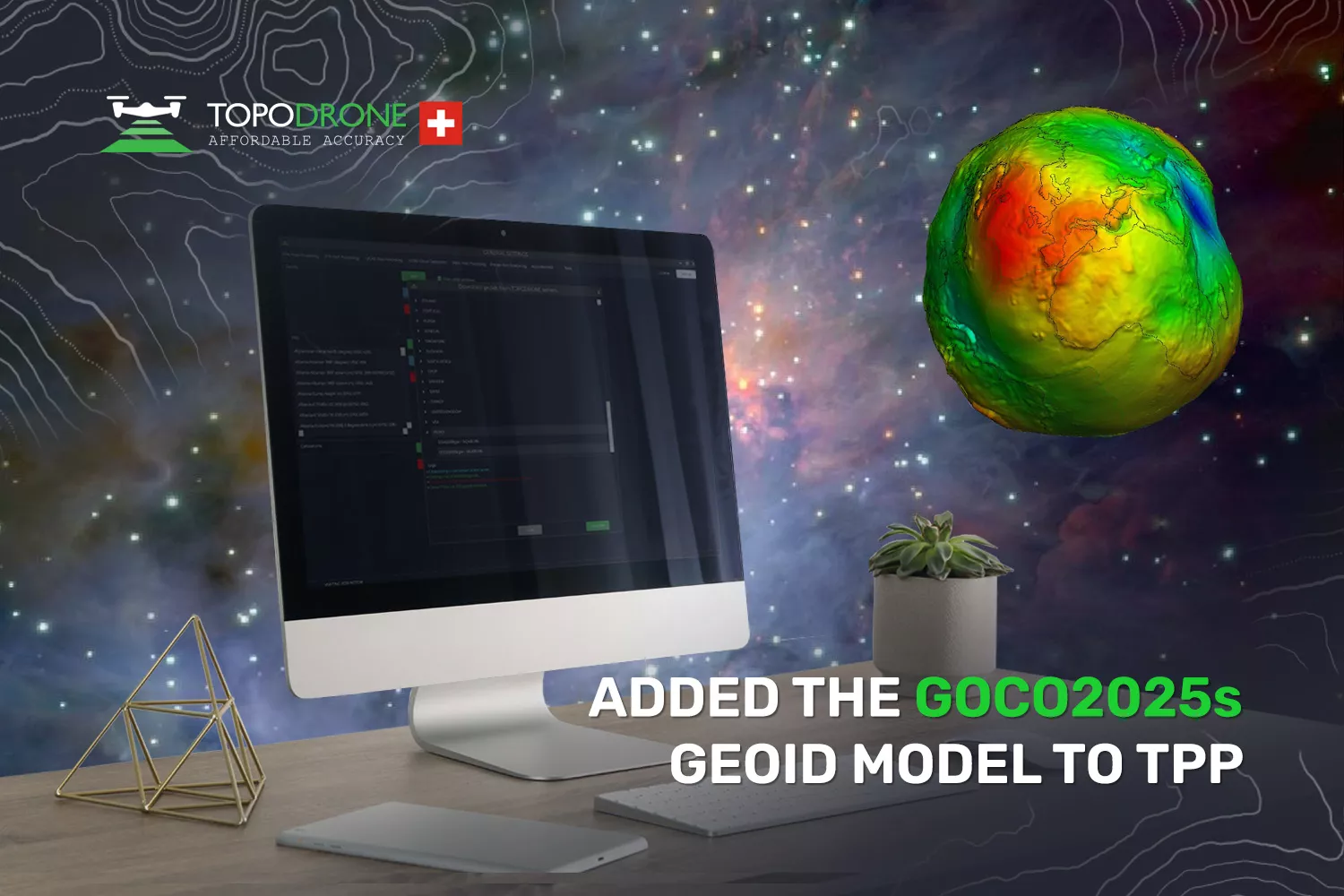
Image 1. GOCO2025s geoid
The global GOCO2025s model has been added to the geoid model library of TOPODRONE Post Processing software. This expands the programme’s capability for converting ellipsoidal heights into normal heights.
Previously, the primary model used for height computation was EGM2008, referenced to WGS84 and the global mean sea level. The addition of GOCO2025s enables more accurate consideration of regional characteristics and provides reliance on modern satellite-derived data.
GOCO2025s Model: a modern global solution
GOCO2025s is the updated 2025 global Earth gravity field model developed by the GOCO consortium. The model resolution reaches degree and order 300 (equivalent to ~67 km at the equator). Up to degree 200, long-term trends as well as annual and semi-annual gravity field variations are taken into account.
Unlike combined models (such as EGM2008), GOCO2025s does not use terrestrial gravimetry or topography, which makes it particularly homogeneous and stable for global-scale applications.
The model is based on satellite observations from 2002–2024, incorporating data from the GOCE, GRACE and GRACE-FO missions, satellite laser ranging (SLR), as well as GNSS orbits (CHAMP, Swarm, Sentinel, TerraSAR-X and others).
Thanks to modern GOCE/GRACE/GRACE-FO data, GOCO2025s provides improved accuracy of long-wavelength geoid components compared to EGM2008, which relies on older datasets. This is especially important for international tasks, cross-border work and global projects: a single up-to-date model reduces discrepancies between regions.
In simple terms, GOCO2025s is a more recent and standardised global geoid.
Visualisation of the GOCO2025s – EGM2008 difference
1. Global difference between GOCO2025s and EGM2008
Areas shown in green represent regions where the models are nearly identical, while the red and blue zones indicate differences reaching several decimetres. As is clearly visible, discrepancies in Europe are minor, whereas in regions with limited terrestrial measurements (mountainous areas of Asia, parts of Africa and South America) the global models diverge much more significantly.
In these areas, the modern satellite-based GOCO2025s model provides more stable results than EGM2008.

Image 2. Difference between the GOCO2025s and EGM2008 geoids
2. Difference over the «problematic» Himalayan region


Images 3–4. Area of maximum discrepancies (the Himalayas and neighbouring regions)
In regions with complex terrain and limited geodetic coverage, the differences between the geoid models become maximal. This is due to the fact that EGM2008 relies on heterogeneous terrestrial data, whereas GOCO2025s uses homogeneous satellite measurements from 2002–2024. For global tasks and surveys over large areas, such a model provides a more reliable basis for deriving heights from GNSS.
How to select and load a geoid model in the software
In TOPODRONE Post Processing, the selection of a geoid model is carried out in the «Settings» → «General» window.

Image 5. Accessing the menu for adding a geoid
On the left side of the «Geoids» window in TOPODRONE Post Processing, click the «Download» button.

Image 6. Downloading the GOCO2025s geoid
In the window that opens, select «WORD» and «GOCO2025s.gtx».

Image 7. Selecting the GOCO2025s geoid from the library
Click «Download». After the download is complete, restart the programme.
The added geoid will appear in the corresponding window.
After downloading or importing, the selected model should be activated in the list. All geoid models (including GOCO2025s) can be added or removed within this window.

Image 8. Display of the selected geoid in the corresponding window
After downloading, ensure that «GOCO2025s» is selected as the geoid model for height computation in the tab corresponding to the task being performed.


Image 9-14. Verification of the added geoid model for use in TPP
During subsequent GNSS post-processing, the programme will automatically apply the selected model for height conversion.
Who will benefit most
High-precision gravity field models such as GOCO2025s are fundamental to many scientific and applied disciplines:
- Oceanography: Accurate knowledge of the geoid (the equipotential surface of the gravity field) makes it possible to compute the absolute sea surface topography and ocean current velocities, which is critically important for studying ocean circulation and climate.
- Geodesy and height systems: The model serves as the basis for determining heights above sea level within a global coordinate system. The difference between the GPS-measured height (relative to the ellipsoid) and the height above the geoid allows coordinates to be converted into orthometric height.
- Geophysical studies: Gravity field analysis assists in investigating the Earth’s internal structure, tectonic processes and mass distribution within the crust and mantle.
Conclusions
GOCO2025s is a modern global model based on satellite data from 2002–2024, suitable for international applications. The model is selected in the programme settings (in the «Geoids» section) — it is sufficient to download the required geoid grid. As a result, users can adapt height computation to their specific task: for work abroad and global projects, GOCO2025s may be used, while retaining the general EGM2008 model when needed.